Heating Requirements for a Bearded Dragon
Along with providing your bearded dragon with proper lighting, you must replicate the heat of the arid desert environment and supply adequate heat.
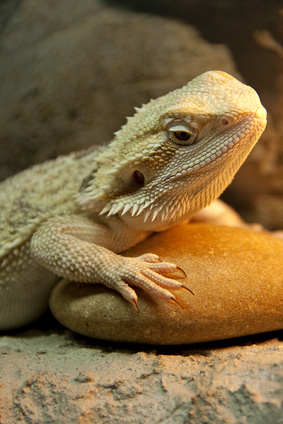 This is accomplished by using incandescent bulbs, heat lamps, and other devices. Just like the fluorescent bulbs mentioned in the previous section, you need to use heat lamps that are specifically designed for reptiles.
Regular household bulbs do not provide enough heat to keep a bearded dragon healthy and comfortable. Here are the proper temperatures for each stage of a bearded dragon’s growth.
Proper Temperatures for a Baby Bearded Dragon (Newborn - 5 Months Old)
The ambient temperatures within the enclosure for a baby bearded dragon should stay at least 80°F (26°C) to 85°F (29°C). A basking area should be established with temperatures ranging between 95°F (35°C) to 110°F (43°C). On the opposite side of the enclosure, the temperatures should be slightly cooler and range between 80°F (26°C) to 90°F (32°C).
Proper Temperatures for a Juvenile Bearded Dragon (5 Months - 18 Months Old)
Juvenile bearded dragons require temperatures slightly cooler, ranging from 95°F (35°C) to 105°F (40°C) in the basking area. The cooler region should be kept around 80°F (26°C) to 90°F (32°C).
Proper Temperatures for Adult Bearded Dragon (Over 18 Months Old)
Adult bearded dragons can have slightly cooler basking areas with temperatures ranging between 90°F (32°C) to 93°F (33°C). The cooler region of the enclosure can still be kept at 80°F (26°C) to 90°F (32°C), just as with babies and juveniles.
Nighttime Temperatures
The nighttime temperatures should drop to 72°F (32°C) to 80°F (26°C) within the enclosure. If the temperatures drop below this after turning the heat and light sources off at night, you may need to use a heating device that does not emit light to supplement heat.
The bright light from a daytime bulb will disturb the bearded dragon’s sleeping patterns. We will discuss nighttime bulbs and heating devices further below.
Thermometers
High quality thermometers should be used in the basking area and in the cooler zones to constantly monitor temperature levels.
You should also provide a good hygrometer within the terrarium to monitor humidity levels. You want to keep the humidity levels around 35% - 40%, but never over 55% inside the terrarium.
There are many very good digital thermometers available for getting fast, accurate readings.
Creating a Temperature Gradient
There should be a consistent temperature gradient across the entire terrarium. The hottest point should be directly under the basking element and the coolest area on the opposite end of the enclosure. The temperature should be the warmest in the basking zones while cooling gradually into the coolest zone.
Bearded dragons regulate their own body heat. They know when they need to bask, and if they begin to get too warm, will move away from the basking spot into a cooler area to cool down. It is very important to provide them with the proper gradient for them to regulate body temperature.
Now, let’s go over the best devices for heating your enclosure.
Heat Basking Lamps
Heat basking lamps are generally incandescent bulbs designed to provide radiant heat for your bearded dragon. They can range in size from 10 watts to 150 watts and come in different variations. For bearded dragons it is recommended to use bulbs designed for basking, such as the Exo Terra Day Glo Basking Tight Beam Bulb, or the Exo Terra Intense Basking Spot Bulb, if you plan to use an incandescent style bulb.
There is also the Exo Terra Halogen Basking Spot Bulb which has a much longer usage life over incandescent bulbs.
These bulbs are generally mounted in a dome-style fixture that includes a high heat ceramic socket. Dome fixtures can usually sit down on top of a screen top, or mounted onto a lamp stand that allows it to safely hang over the enclosure top.
Mercury Vapor Bulbs
As mentioned in the Lighting section, Mercury Vapor bulbs provide UVA/UVB radiation and is a good heat source. This is a viable option in order to reduce the amount of bulbs needed in order to provide both basking heat and ultraviolet radiation.
It is recommend that if you do decide to use a Mercury Vapor bulb that it be used in unison with a fluorescent style bulb to spread the ultraviolet radiation across the entire enclosure.
Ceramic Heat Emitters
Ceramic heat emitters give off radiant heat, but do not provide any visible light. They are mounted in a ceramic light fixture just like a basking or Mercury Vapor bulb.
These devices are generally used as supplement heat, or for nighttime heat. Ceramic heat emitters are ideal for nighttime use due to the lack of visible light. The most common wattages are found in either 60 watts or 100 watts.
Nighttime Bulbs
As mentioned previously, nighttime bulbs are used to simulate nighttime. These are the times when bearded dragons rest, much like humans do. These bulbs also support some nocturnal activity.
Nighttime bulbs are usually incandescent bulbs with lower wattages used to supply some heat while providing very little light. They are usually found in black, which produces a very dim purplish glow, or red which gives a dim red glow in the enclosure that bearded dragons can not detect.
Ceramic heat emitters and undertank heat pads can also be used to supply small amounts of heat without producing disturbing light.
Undertank Heat Pads
Undertank Heat Pads (sometimes referred to as Substrate Heaters) are flat pads that stick to the bottom, or side, of a terrarium and give off a low, gradient heat. These are generally used to provide supplemental heat from below, or to warm the substrate.
Undertank heaters are a good option to use to supplement heat and warm the substrate during cold winter months.
Heat Rocks
Heat rocks are heating elements that are shaped to resemble realistic rocks and placed inside the terrarium to provide heat. Although they are still widely sold in the pet market, they are not recommended for use.
Next, let’s jump on the topic of substrate and terrarium decor items.